


The German citation style is not included in Zotero. While Zotero comes with over 10,000 citation styles, none of them comply with German footnote conventions—such as the use of "cf.", "ibid.", and short references within the footnote. Therefore, anyone using the German citation style requires an additional CSL style.
Ready-made CSL styles for the German citation style are available from Citation Styler—offered in two variants depending on your institute's requirements. The files are continuously updated for new versions of Zotero and cover footnotes, repeated citations using "ibid.", secondary citations, and edited volumes and online sources. Alternatively, you can create your own style using the CSL editor; this requires knowledge of CSL-XML and, depending on the desired level of customisation, can take many hours of work.
Are you studying at a German-speaking university and your professor has prescribed that you use the so-called ‘German citation style’?
Then you've probably already noticed:
👉 In Zotero, there is no distinct style simply called ‘German citation style’.
👉 And that is precisely not a mistake, but the actual problem.
In this article, you will learn:
- What is really meant by ‘German citation style/Deutsche Zitierweise’
- Why standard Zotero styles won't get you far
- How you can still use Zotero to cite clean, guideline compliant and stress-free .
- And when you should look into a custom citation style , instead of endlessly trying around
What does ‘Deutsche Zitierweise’ actually mean?
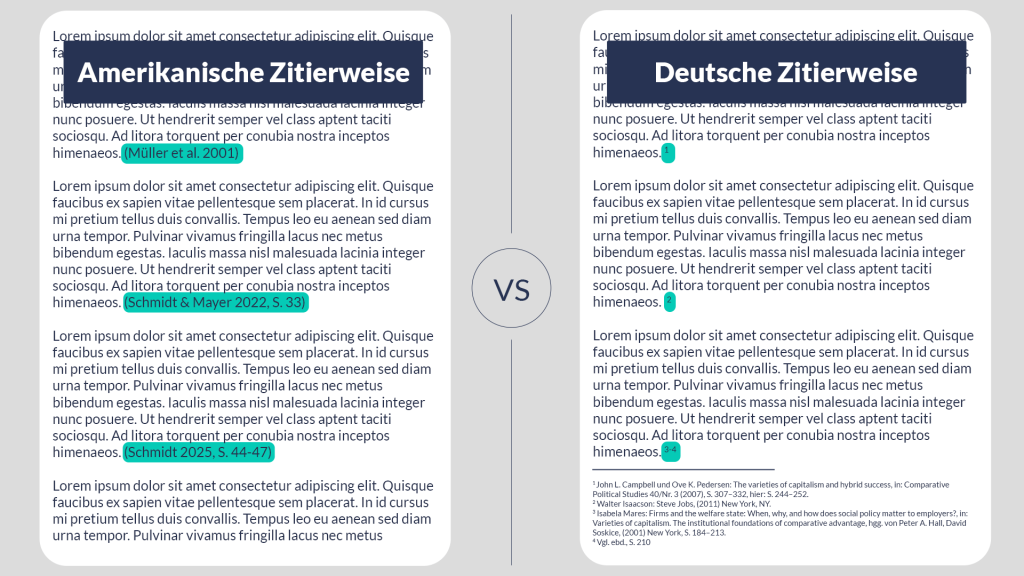
The term 'Deutsche Zitierweise' is no uniformly defined citation style.
In practice, it usually just means:
- Cite with footnotes
- kein Autor-Datum im Text (also keine american style bzw. „Autor Datum“ oder „Harvard“)
- a your bibliography at the end
👉 How exactly these footnotes should look like, can differ quite massively:
- order of information
- abbreviations
- italics
- page information
- subsequent citations (short or ibid.)
- output for online sources
That is why many institutions say ‘German citation style’ but actually mean:
‘Our own internally defined footnote style.’
Why there cannot be a universal Zotero style for this
Zotero works with so-called CSL citation styles. These are precise styles – they have to be.
A style defines, amongst other things:
- which metadata fields to output
- in which order
- with which punctuation
- and under which conditions
If a university only says:
'Cite following the German citation style'
... there is simply not enough information to implement this correctly.
Result in practice:
- Students try out 5-10 styles
- manually adjust footnotes
- lose hours (or nights) over this
- and are still uncertain
Zotero is not the problem – unclear guidelines are
Important:
👉 Zotero works brilliantly, but only if a style is clearly defined
As soon as an institution:
- provides specific examples
- or guidelines exist
- oder sich an einer bekannten Quelle orientiert (z. B. Scribbr)
.. an exact citation style can be coded that:
- automatically formats correctly
- is reproducible
- doesn't require manual editing
This is exactly where I come in.
Two proven solutions for ‘Deutsche Zitierweise’ in Zotero
Over the years, I have received countless enquiries on this subject.
In the process, the following two clearly defined variants emerged for which concrete guidelines exist.
1) Deutsche Zitierweise für Zotero
This style reflects a classic, frequently requested footnote logic that is accepted at many German-speaking universities.
👉 Suitable when:
- You want to use a style that is also used by hundreds of other students.
- Your institution requires the ‘Deutsche Zitierweise’ without further specific guidelines.
- Example footnotes look similar.
- You want to use a solid, proven standard.

2) Citation style Deutsche Zitierweise according to Scribbr
This style is based precisely on the publicly documented Scribbr guidelines.
👉 Suitable when:
- the example citations shown correspond to how you imagine them to be
- Your institution follows exactly these Scribbr guidelines
- Maximum transparency is required

Important:
Please check the shown examples before buying . If you are unsure, you can contact me at any time.
When a ready-made style isn't enough
In such cases, you need no pre-made style, but a customised solution:
- The institute has their own PDF guidelines.
- Special rules for first/subsequent citations
- Special requirements for online sources
- Publisher or publishing house with their own specifications
➡️ In such cases, I create bespoke Zotero citation styles, perfectly matching and compliant to the guidelines (note though that I already have 100+ custom styles ready to order)
This saves you time, stress and discussions when handing in your work.
Brief explanation: How to use Zotero with footnotes (without detailed setup)
You don't need a long instruction manual here – just the essentials:
- Install Zotero
- Import your sources
- Install your citation style
- Cite in Word / LibreOffice
- Generate your bibliography
👉 You can find detailed instructions here: Citing correctly with Zotero
Why a bespoke citation style is worthwhile
Many students hesitate because of the price.
That's understandable – but be honest:
- 3-5 hours of manual corrections
- Uncertainty until submission
- Risk of point deductions
A properly coded style means:
- one click instead of night shifts
- consistency
- a clean bibliography
- You can focus on the content of your work
Ready-made style or create your own?
Zotero’s CSL editor is suitable for making minor adjustments to existing styles. However, this is usually insufficient for the German citation style, as the logic governing footnotes, short citations, and "ibid." rules must all work in concert. Creating the style from scratch requires knowledge of CSL-XML and—depending on the desired level of sophistication—several hours of work.
A verified style costs a one-time fee of €39.99 and is ready for immediate use in Zotero after downloading: consistent footnotes, correct short citations, a clean bibliography—and no manual corrections before submission.
Summary
The 'Deutsche Zitierweise' is not a single style, but a collective term.
Genau deshalb scheitern so viele Studierende daran, „den einen“ passenden Zitierstil zu finden.
With Zotero and the correct citation style citing will once again become what it should be:
A technical aid, not a time waster!
If you are unsure which style suits your requirements:
👉 Send me a message . I'd be happy to help.
Good luck with your work – and when it comes to handing in your paper/thesis.
FAQ - Frequently Asked Questions
Is there a ready-made CSL style for the German citation style?
Yes, though not just one. Zotero does not include a style named "Deutsche Zitierweise" (German citation style) because the term does not refer to a single, uniformly defined citation style, but rather serves as a collective term for footnote-based citation styles. Citation Styler offers two ready-made CSL styles for this purpose: "Deutsche Zitierweise für Zotero" as a proven standard, and "Deutsche Zitierweise nach Scribbr" for institutions that follow Scribbr guidelines.
Which of the two styles is the right one for me?
The example footnotes in your institute’s guidelines are the deciding factor. If the manual mandates the Scribbr guidelines—or if the examples align with them—then the Scribbr style is the right choice. If there is only a general requirement for the "German citation style" without further details, the standard style is the usual choice. Both styles display sample output before purchase.
What is the difference between the German citation style and the Harvard style?
The German citation style documents sources in footnotes, whereas the Harvard or American citation style uses author-year references within the running text. Both systems require different CSL styles; an author-year style cannot be converted into a footnote citation style simply by changing settings.
What if my institution has its own guidelines?
Then a standard style is usually not enough. For custom PDF guidelines, special rules for first and subsequent citations, or specific requirements for online sources, a custom Zotero citation style can be created precisely according to your specifications. You can do this by requesting a custom styleOtherwise, it's also advisable to check my shop for your specific universitz first.
Does the style work in Zotero 10+?
Yes. CSL styles are independent of the Zotero version; a style that works in older versions will also work in Zotero 10.