When it comes to academic work in Germany, ‘Theisen’ is a term that comes up in many seminars and lectures. The book „Wissenschaftliches Arbeiten – Erfolgreich bei Bachelor- und Masterarbeit“ by Manuel René Theisen, now in its 19th edition (2024), has established itself as a standard reference work and serves as the basis for academic citation at numerous universities. However, as widespread as the Theisen citation style is, it is applied in very different ways in practice.
The Theisen citation style in academic papers
The Theisen citation style provides clear guidelines on how to cite sources correctly and how the reference list should be formatted. It is particularly precise and places great emphasis on consistency and completeness, making it a popular choice. Many universities, universities of applied sciences and academic institutions use this style to ensure a consistent approach to citing sources in students’ academic work. Indeed, an impressive number of study regulations and guidelines refer to Theisen’s work, which underlines its relevance and acceptance in the academic world.
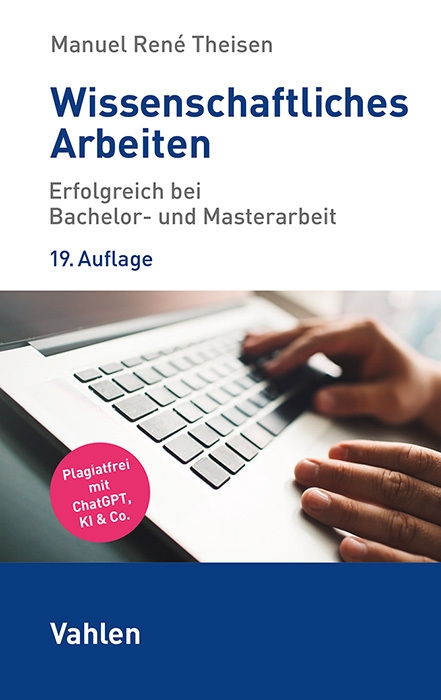
Theisen – Wissenschaftliches Arbeiten – Buchcover
Customised citation styles for your university
To address these challenges, Citationstyler.com provides a variety of developed citation styles which are specifically tailored to the varying requirements of universities. These styles are often based on the Theisen citation style, but also take into account the specific adaptations made by individual universities. By using the correct style, you can be sure that your work meets your university’s citation requirements exactly.
Discrepancies at universities: A common problem
Despite the widespread use of the Theisen citation style, there is a common problem: many universities that claim to use this style actually make their own adjustments to it. It is not uncommon for students to be surprised to discover that the citation style they are required to use, as specified by their university, contains minor but significant deviations from the original Theisen style. These variations may relate to details such as the formatting of references, the treatment of multiple authors, or the placement of punctuation marks. Simply replacing a comma with a full stop is enough to make it a new style.
Such differences can be confusing for students and may lead to marks being deducted or even allegations of plagiarism if the citation guidelines are not followed correctly. So ‘Theisen’ is no longer ‘Theisen’!
Custom citation styles available on request
If your university’s style is not yet included in my range, I also offer custom-made citation styles . On request, I can create a citation style tailored precisely to your university’s requirements, usually within 3 days. This allows you to concentrate fully on your academic work without having to worry about any discrepancies in the citation style.
Summary
The Theisen citation style is a tried and tested basis for academic work in German-speaking countries, but many universities make their own adjustments, which students must take into account. On Citationstyler.com you’ll find ready-made citation styles tailored precisely to your university’s requirements – and if not, I’ll be happy to create a custom style for you. That way, you can be sure that your work meets your university’s formal requirements in every respect.
Find the right citation style for your university now and avoid unnecessary errors when citing sources!
Master the art of presenting statistical results in your thesis. Learn how to present your results clearly, concisely and in a way that is easy for your readers to understand.
Zotero can save you a tremendous amount of time in your academic work – if you use it correctly. In this article, you will find 9 tried and tested Zotero tips from real-world experience.
We use cookies to improve your browsing experience, display personalised adverts or content, and analyse our website traffic. By clicking ‘Accept all’, you consent to the use of cookies. You can change or withdraw your consent at any time by clicking the settings icon.
Adjust settings
We use cookies to enable you to navigate our website efficiently and to carry out certain functions. You can find detailed information on all cookies below, under the relevant consent categories.
Cookies classified as ‘necessary’ are stored in your browser, as they are essential for the website’s basic functions.
We also use third-party cookies to help us analyse your use of this website, save your settings and provide you with content and marketing materials that are relevant to you. These cookies are only stored in your browser with your prior consent.
You can enable or disable some or all of these cookies; however, disabling some of them may affect your browsing experience.
Always Active
Necessary cookies are required to enable the basic features of this site, such as providing secure log-in or adjusting your consent preferences. They are not used for advertising or to track you across other sites. The consent cookie stores a random identifier that lets us keep a record of the choice you made.
Cookie
PHPSESSID
Duration
session
Description
PHP session cookie for managing user sessions.
Cookie
selectedTab
Duration
session
Description
Cookie
woocommerce_items_in_cart
Duration
session
Description
WooCommerce cookie to track items in cart.
Cookie
woocommerce_cart_hash
Duration
session
Description
WooCommerce cookie to determine cart contents changes.
Cookie
_GRECAPTCHA
Duration
6 months
Description
Used by Google reCAPTCHA to distinguish between humans and bots.
Cookie
fazcookie-consent
Duration
6 months
Description
Stores the visitor’s cookie consent choices and a random consent ID used to keep a record of this choice.
Always Active
Functional cookies help perform certain functionalities like sharing the content of the website on social media platforms, collecting feedback, and other third-party features.
Cookie
timezone
Duration
session
Description
No description available
Cookie
tk_ai
Duration
session
Description
Stores a randomly-generated anonymous ID. This is only used within the dashboard (/wp-admin) area and is used for usage tracking, if enabled.
Cookie
wmc_current_currency
Duration
1 day
Description
Cookie supplied by Woo Multi-Currency
Cookie
__stripe_mid
Duration
1 year
Description
Stripe fraud prevention cookie for payment processing.
Cookie
__stripe_sid
Duration
30 minutes
Description
Stripe fraud prevention session cookie for payment processing.
Cookie
cf_clearance
Duration
session
Description
Whether a CAPTCHA or Javascript challenge has been solved.
Cookie
LOGIN_INFO
Duration
2 years
Description
This cookie is used to play YouTube videos embedded on the website.
Always Active
Analytical cookies are used to understand how visitors interact with the website. These cookies help provide information on metrics such as the number of visitors, bounce rate, traffic source, etc.
Google Analytics 4 cookie used to persist session state.
Cookie
_ga
Duration
2 years
Description
Google Analytics cookie used to distinguish users.
Cookie
sbjs_migrations
Duration
session
Description
Technical data to help with migrations between different versions of the tracking feature
Cookie
sbjs_current_add
Duration
session
Description
Timestamp, referring URL, and entry page for your visitor’s current visit to your store
Cookie
sbjs_first_add
Duration
session
Description
Timestamp, referring URL, and entry page for your visitor’s first visit to your store (only applicable if the visitor returns before the session expires)
Cookie
sbjs_current
Duration
session
Description
Traffic origin information for the visitor’s current visit to your store
Cookie
sbjs_first
Duration
session
Description
Traffic origin information for the visitor’s first visit to your store (only applicable if the visitor returns before the session expires)
Cookie
sbjs_udata
Duration
session
Description
Information about the visitor’s user agent, such as IP, the browser, and the device type
Cookie
_clsk
Duration
1 day
Description
Microsoft Clarity session cookie.
Cookie
_gid
Duration
24 hours
Description
Google Analytics cookie used to distinguish users.
Cookie
_gat
Duration
1 minute
Description
Google Analytics cookie used to throttle request rate.
Cookie
CLID
Duration
1 year
Description
The cookie is set by embedded Microsoft Clarity scripts. The purpose of this cookie is for heatmap and session recording.
Always Active
Performance cookies are used to understand and analyse the key performance indexes of the website which helps in delivering a better user experience for the visitors.
No cookies to display.
Always Active
Cookies that have not yet been categorized.
No cookies to display.
Always Active
Marketing cookies are used to provide visitors with customised ads based on the pages you visited previously and to analyse the effectiveness of the ad campaigns.
Cookie
sib_cuid
Duration
session
Description
Used by Sendinblue to link website activity with marketing campaigns. Facilitates marketing automation, personalization, lead scoring, and retargeting.
Cookie
_gcl_au
Duration
90 days
Description
Google Ads conversion linker cookie.
Cookie
_fbp
Duration
3 months
Description
Facebook Pixel cookie used for advertising and analytics.
Cookie
YSC
Duration
session
Description
YouTube cookie used to track views of embedded videos.
Cookie
VISITOR_INFO1_LIVE
Duration
6 months
Description
YouTube cookie used to estimate bandwidth and display settings.