Introduction: Why reference managers are important
Anyone who writes scientific papers on a regular basis will encounter a reference manager hardly over. Such tools help to centrally collect, organise and consistently cite literature from databases, catalogues, websites and PDFs.
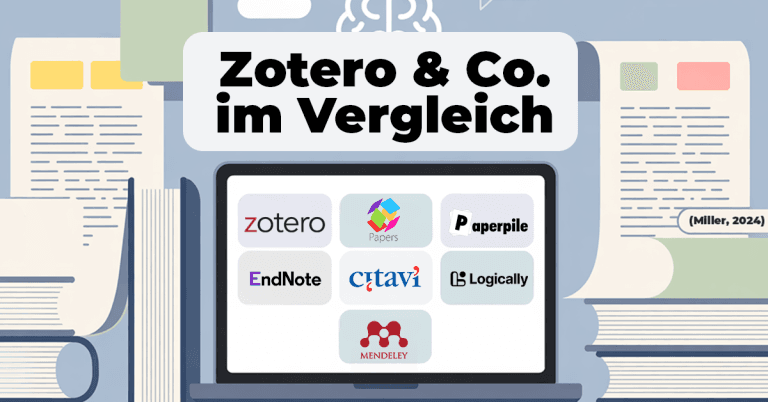
This article compares established tools such as Zotero, Mendeley, Citavi, EndNote, Paperpile and Papers, as well as newer AI-powered solutions such as Logically, without naming a test winner. The aim is to provide a sober overview of strengths, weaknesses and typical use cases so that you can decide for yourself what suits your workflow.
Criteria for a fair comparison
For an objective comparison, it is worth taking a look at some key criteria:
Platforms and ecosystem (desktop, web, mobile)
Range of functions (import, organisation, PDF annotation, collaboration)
Integration into word processing (Word, LibreOffice, Google Docs, LaTeX)
Cost model and data sovereignty
Scope and flexibility of available citation styles
Support
Advanced features such as AI-powered search, summaries and analysis
The tools in comparison
Zotero: Open, flexible, community-driven
Zotero is a free, open-source programme for literature management and has established itself worldwide in academic circles. It serves as a personal research assistant for collecting, organising, annotating, citing and sharing literature.
Platforms: Desktop app for Windows, macOS and Linux, plus apps for Android and iPhones.
Functionalities: Automatic import from catalogues and databases, integrated PDF viewer with annotations, group libraries and large plugin ecosystem.
Citation styles: Extensive catalogue of predefined styles thanks to the Citation Style Language library (more than 10,000 citation styles for journals, magazines and publishers); custom styles can be created or adapted.
Cost: Use of the software is free of charge (only additional cloud storage beyond a free quota is subject to a fee, but can also be expanded free of charge via WebDav).
Support: Support happens in the Zotero forumswhere developers and community members help and give guidance.
Zotero is particularly suitable for users who value openness, expandability, first-class support and long-term data sovereignty.
Mendeley: Cloud-based solution in the publishing system
Mendeley is a proprietary reference manager owned by a publishing company and heavily geared towards cloud synchronisation and collaboration. I also used it before the ‘new’ Mendeley Desktop was released.
Platforms: Desktop applications, web interface (no mobile applications)
Functionalities: PDF annotation, shared group folders, integration with publishing and database services.
Citation styles: Extensive catalogue of citation styles thanks to the work of the Citation Style Language project.
Cost: Basic version free of charge; storage space and some convenience features follow a freemium model.
Support: Since Elsevier acquired Mendeley, support has declined significantly. Users have even come to the Zotero forum with questions because they were unable to get help elsewhere.
Mendeley offers a convenient cloud workflow, but is much more closely tied to a proprietary infrastructure. Development and bug fixes are slow.
Citavi: Literature management plus knowledge organisation
Citavi is particularly widespread in German-speaking countries and combines literature management with sophisticated knowledge organisation.
Platforms: Focus on Windows desktop, with additional cloud components.
Citation styles: Comprehensive (~11,000) set of proprietary style templates, including many German-language and subject-specific styles; style editor for customisation. Special licensing model, often campus or institute licences.
Cost: Commercial licence model, often campus or institute licences.
Support: Very helpful and knowledgeable, according to many reviews, quick and personalised responses; some criticism of purely email-based channels and time differences for enquiries from other regions.
Citavi is particularly interesting if literature needs to be deeply indexed and structured in terms of content within the framework of complex projects, if the university already has a licence, and if specific German-language styles are required.
EndNote: Established heavyweight for demanding workflows
EndNote is one of the oldest reference managers and is often used by research institutions and universities.
Platforms: Desktop versions for Windows and macOS plus online component for synchronisation.
Functionalities: Extensive import filters, numerous fields and configuration options, great flexibility when managing very large libraries.
Citation styles: Very large number of proprietary styles, including many journal specifications; powerful style editor for detailed customisation.
Cost: Licences subject to a fee, often provided by institutions.
Support: User reviews range from ‘helpful and solution-oriented’ to ‘difficult to reach’; support articles are comprehensive, but direct personal support is sometimes described as needing improvement.
EndNote is one of the oldest reference managers on the market. This means that the software is often already firmly established in the infrastructure and users are familiar with it. However, this also makes EndNote seem outdated and rather
Paperpile: Lean, browser-centric, Google Docs-powered
Paperpile is a modern, web-based reference manager with a strong focus on browser and Google Docs workflows.
Platforms: Web app and browser extensions, supplemented by mobile apps.
Features: Fast import from databases, automatic metadata recognition, convenient PDF management, tight integration with Google Drive and Google Docs.
Citation styles: Very large catalogue of predefined styles that can be selected directly in the document; suitable templates exist for most journals.
Cost: Proprietary subscription model.
Support: Mostly very positive feedback; support responds quickly, communicates clearly and provides workarounds and bug fixes promptly.
Paperpile is ideal if you mainly work in your browser and Google Docs and want to maintain as little local software as possible.
Papers: Modern interface with SmartCite plugin
Papers combines literature management, PDF reading functions and its own citation plugin for common word processing programmes.
Platforms: Desktop applications and cloud backend, with add-ins for writing programmes (e.g. SmartCite).
Functionalities: Management of large libraries, annotation of PDFs, search functions, integration into writing processes.
Citation styles: Access to numerous predefined styles; furthermore, additional styles can be integrated or adapted to meet journal requirements.
Cost: Proprietary subscription model.
Support: Overall solid, but less consistently documented; user reports range from helpful support to occasionally slow responses to enquiries.
Papers is aimed at users who want to combine a modern interface with a tightly integrated citation plugin.
Logically & Co.: AI-powered research assistants
Newer tools such as Logically focus less on pure reference administration and more on research, summary and the analysis of texts.
Platforms: Predominantly cloud-based web applications with browser extensions.
Functionalities: AI-supported summaries, semantic search, question-and-answer functions for PDFs and articles, often combined with classic management functions.
Citation styles: Mostly connection to existing citation style collections or export functions that allow literature to be integrated into other citation environments.
Cost: Usually freemium models with limited use in the free tariff and extended quotas in the subscription.
Support: In terms of functionality, fast pace and some helpful responses, but overall inconsistent experiences; particularly with regard to rebranding and contract changes, some users report non-transparent decisions and unreliable communication.
Logically is a newer software that relies primarily on AI. (Zotero and Mendeley can also work with ChatGPT and similar programmes). Such tools complement traditional reference managers and are particularly useful during intensive reading and writing phases, but they often cannot replace a fully-fledged and mature literature management system such as Zotero.
Overview table: Comparison of key features
Criteria
Zotero
Mendeley
Citavi
EndNote
Logically & AI tools
Paperpile
Papers
Licence model
Open source, free
Proprietary, freemium
Commercial, often institutional licences
Commercial
Proprietary, freemium
Proprietary subscription
Proprietary subscription
Platforms
Win/macOS/Linux, iOS, Android
Win/macOS, Web, Mobile
Windows, Cloud
Win/Mac, web
Web
Web, Desktop iOS, Android
Cloud
Focus
Literature management, community plugins
Cloud & Collaboration
Knowledge organisation & projects
Professional features, large libraries
AI research & analysis
Google Workspace integration
SmartCite citation & reading
PDF annotations
Integrated (viewer + notes)
Integrated
Integrated
Integrated
Integrated, partly via AI
Integrated
Integrated
Available citation styles
CSL library with 10,000+ styles
CSL library with 10,000+ styles
Extensive proprietary style collection
Very large proprietary style collection
CSL library with 10,000+ styles
CSL library with 10,000+ styles
CSL library with 10,000+ styles
When which tool is useful
Which reference manager is ‘right’ for you depends largely on your environment, your projects and institutional requirements. Here are some typical scenarios:
If you want to remain independent in the long term and value openness: Zotero offers free software, flexible data storage and a large community.
If cloud collaboration is a priority: Paperpile or Papers offer synchronised libraries and well-integrated online workflows.
If your university or institution has licences for EndNote or Citavi, it is often worth using them, especially because training and even help desks are available for them.
If you would also like AI-supported analysis, summarisation and research, tools such as Logically are a useful addition to traditional solutions, especially during intensive reading and writing phases.
Finally, it is worth taking a closer look at the structural features of Zotero that distinguish it from many proprietary alternatives.
Zotero is a open-source project; the source code is publicly available and is not controlled by a single commercial provider.
Zotero is backed by public and non-profit funding and a sustainable model based on voluntarily paid cloud storage, not the sale of user data or aggressive subscription lock-in.
A large international community of developers and users provides extensions, styles, translations and quick bug fixes.
Zotero has been continuously developed for around two decades, with regular major updates and a stable roadmap.
In practice, this means that Zotero is free to use, has proven itself over many years, and is not at risk of suddenly disappearing from the market or being redesigned in a way that would leave users facing a fait accompli overnight. Anyone looking for a long-term, stable, expandable, and transparently licensed basis for their own literature management will therefore find Zotero to be a particularly reliable option.
Learn how to change all entries in Zotero at once by using the Zotero Search & Replace Script. A simple guide to using the script for efficient reference management.
Comparison of citation software: Which tool is the best for your academic work? We analyse the development of Zotero, Mendeley, EndNote, JabRef and Citavi and show you which program is currently in vogue.