The use of citation and reference management software has changed considerably over the last few years. This development can be easily studied on the basis of search behaviour on Google. We look at the popularity of five well-known programmes: Zotero, Mendeley, EndNote, JabRef and Citavi.
Development of search queries
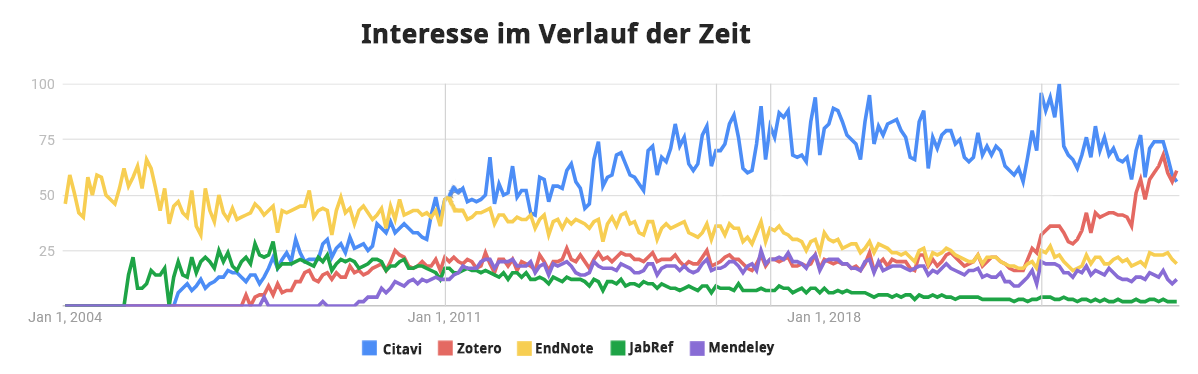
The following graphic from Google Trends shows a comparison of the relative search interest for the five programmes from January 2004 to July 2024.
Citation software search in comparison since 2004. Graphic from Google Trends.
Clear trends can be recognised here:
Zotero: This open-source tool has steadily grown in popularity. Especially since 2021, there has been a steep increase, probably due to improvements in user-friendliness and the growing community. Zotero is particularly appreciated by academics who are looking for a free and flexible solution that has excellent support and a very active community of Plugin Developers.
Mendeley: After a strong growth phase from 2009 to 2016, Mendeley has more or less maintained its popularity, but has shown a downward trend since 2018. This could be related to the takeover by Elsevier and the associated changes to the software, which were met with displeasure by some users.
EndNote: The established ‘corporate’ software, which was/is often accessible via subscriptions at universities, shows a fairly constant decline since ~2011. EndNote is widely used especially in institutional environments, but competition from free alternatives seems to be increasing.
JabRef: As a lesser-known but powerful open-source tool, JabRef shows a stable but comparatively low search frequency and a steadily decreasing trend. JabRef's niche consists mainly of users who require specialised BibTeX management. However, this can now be covered very easily by Zotero.
Citavi: This software, which is particularly popular in German-speaking countries, shows a mixed picture. After a phase of growth until 2017, its popularity has declined somewhat, but could increase again thanks to new functions and integrations.
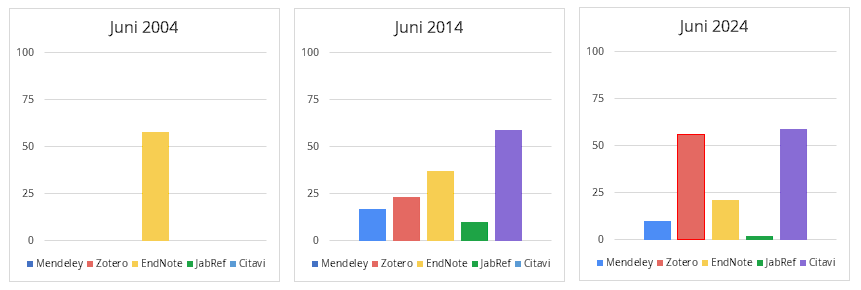
The 5 programmes at a glance in June 2004, 2014 and 2024.
The graphic above clearly shows how strong and widespread EndNote once was, but has now almost been replaced by Zotero and Citavi. Even Mendeley can no longer keep up and has been left behind. As a very active member of the Zotero community, we have received many requests for help in the forum, especially in the last two years, when migrating from Mendeley to Zotero.
The data shows that the market for citation and reference management software is evolving dynamically and both established and new tools need to constantly expand their user base to remain relevant. Academics and researchers benefit from this diversity through greater choice and better customisation options to suit their individual needs.
Some key factors for the future development of citation software are:
User friendliness: Tools that enable intuitive use will continue to gain in popularity.
Collaboration functions: With the increasing importance of teamwork in research, programmes with strong collaboration features are preferred.
Integrations: The ability to integrate seamlessly with other research and writing tools is a key advantage.
Mobility: The ability to read or take notes seamlessly on a tablet or mobile phone and then have them available anywhere is crucial.
As a Zotero user and CSL developer, I am of course a big believer in Zotero, but I have used Mendeley for years. If you want to learn more about Zotero, I have a an article on the topic.
Zoplicate is a powerful Zotero plugin that efficiently recognises and merges duplicate entries. It offers advanced duplicate detection and saves time when managing large literature databases.
Which literature management system is right for you? Comparison of Zotero, Mendeley, Citavi, EndNote, Paperpile, Papers and Logically – including styles, support and future-proofing.